Launch offer — valid today only

📄 Digital book in PDF · read it on your phone or print it

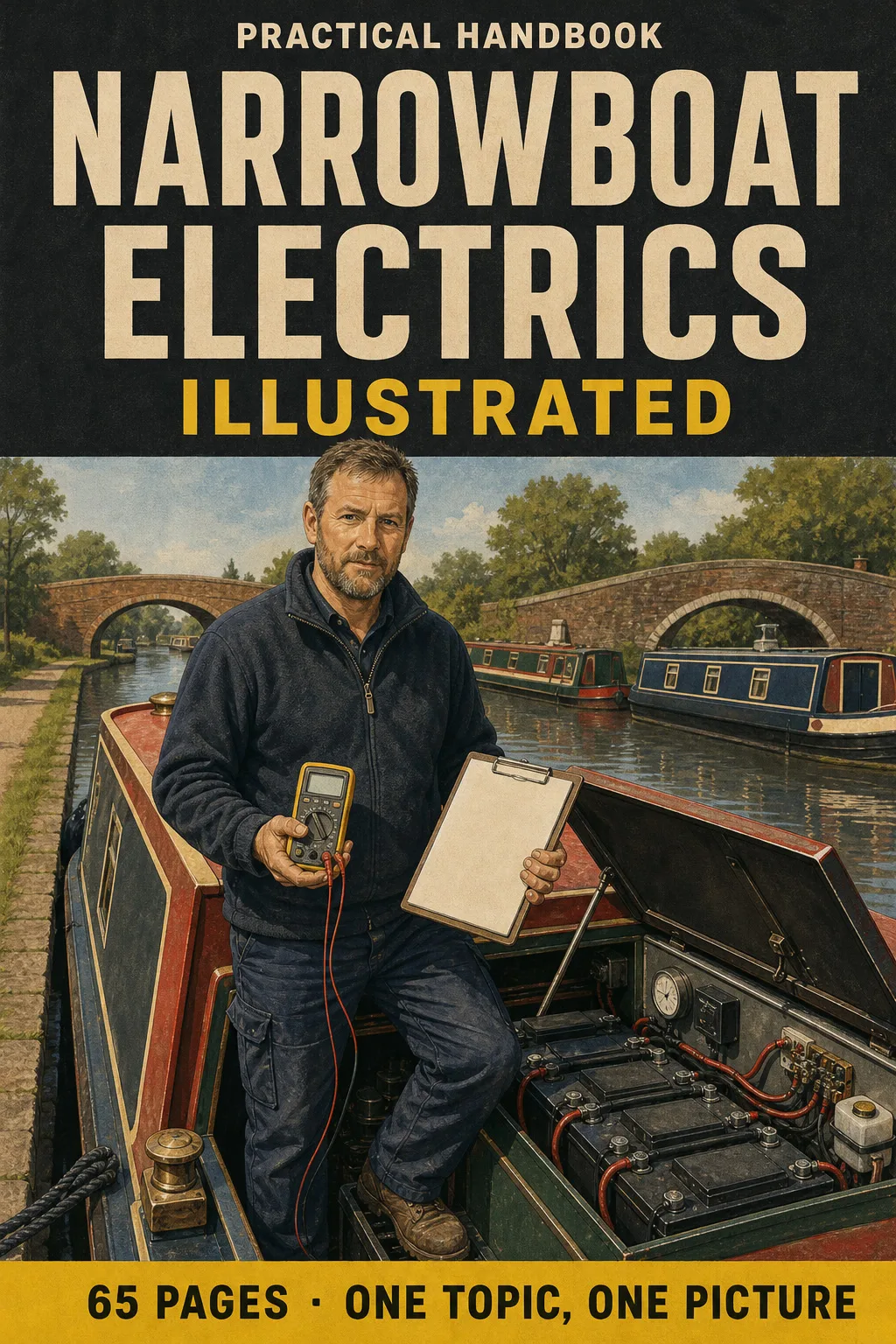
Narrowboat 12 V and Shore Power in Drawings Every Circuit on Its Own Page

Batteries flat by morning? See whether it's the alternator, the split charge, the inverter or the bank itself. Written for UK narrowboats: 12 V, solar, 230 V shore power, fuses, cable sizing and fault finding, each on its own page, the drawing first. 65 illustrated pages.

YES, I WANT MY BOAT'S ELECTRICS DRAWN

🔒 Secure checkout · PDF by email · 30-day guarantee

Every topic, its own pageEach circuit drawn, with the explanation alongside
65 illustrated pages8 parts, from the whole system in one drawing to the key numbers on one page
Up-to-date sourcesBoat Safety Scheme checks, BS EN ISO 13297 (boat electrics) and BS 7671 Section 709 (marinas)
PDF by emailFormat

Look Inside the Book

Each page has one big drawing and a box with the voltages, numbers and steps you need to know:

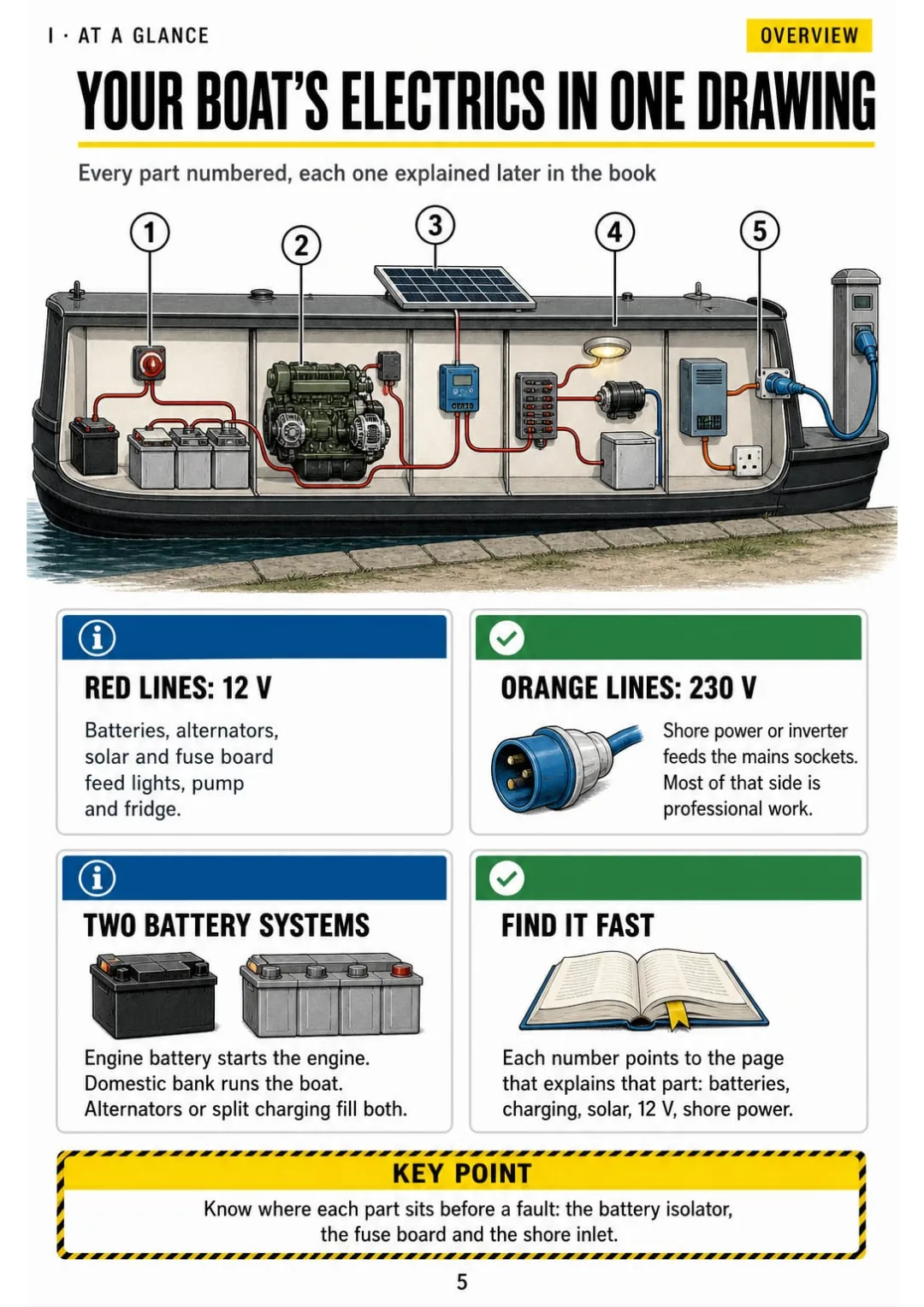
Five numbered groups, two colours: 12 V in red, 230 V in orange.
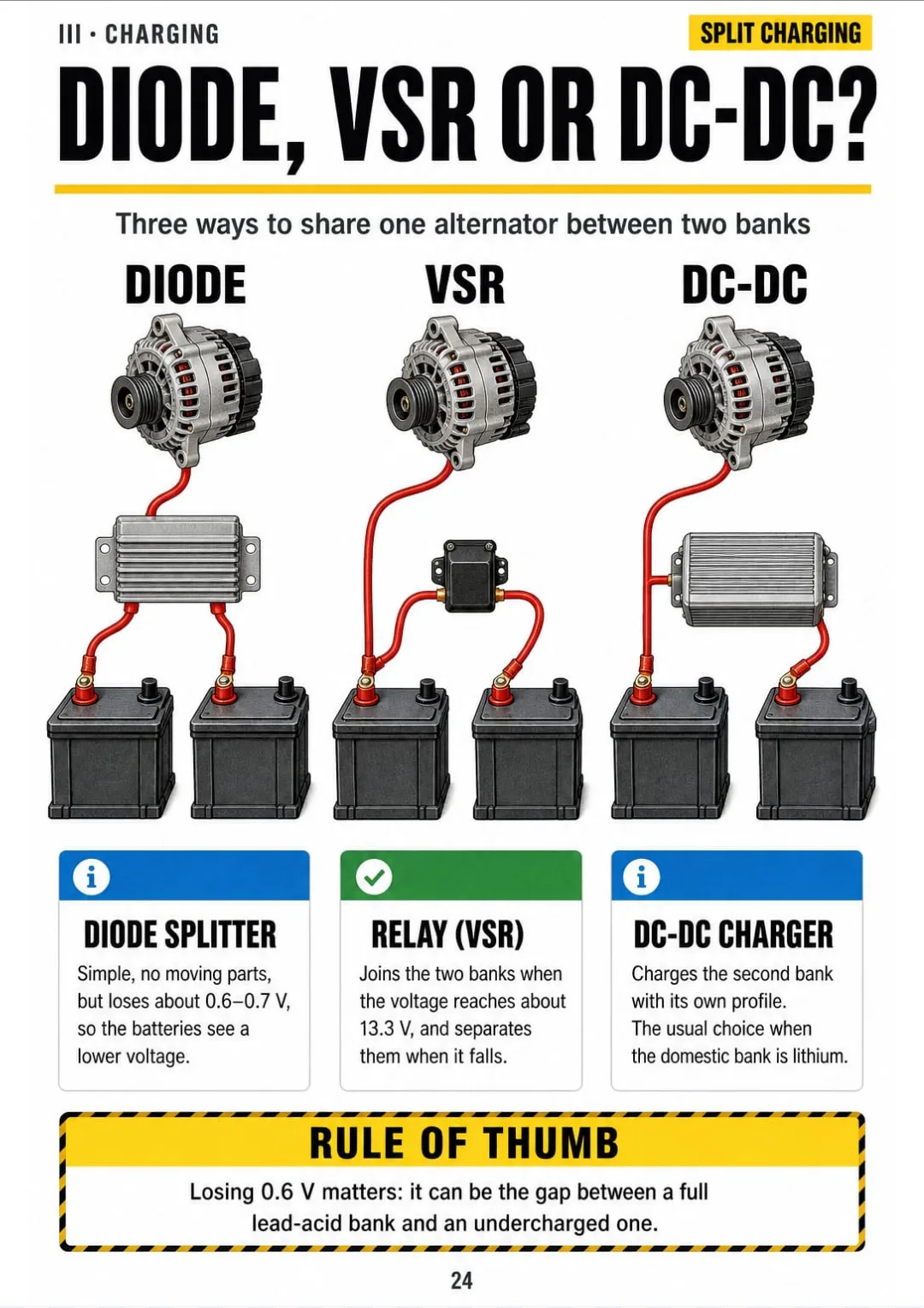
Diode loses about 0.6–0.7 V; a VSR joins at about 13.3 V; DC-DC suits lithium.
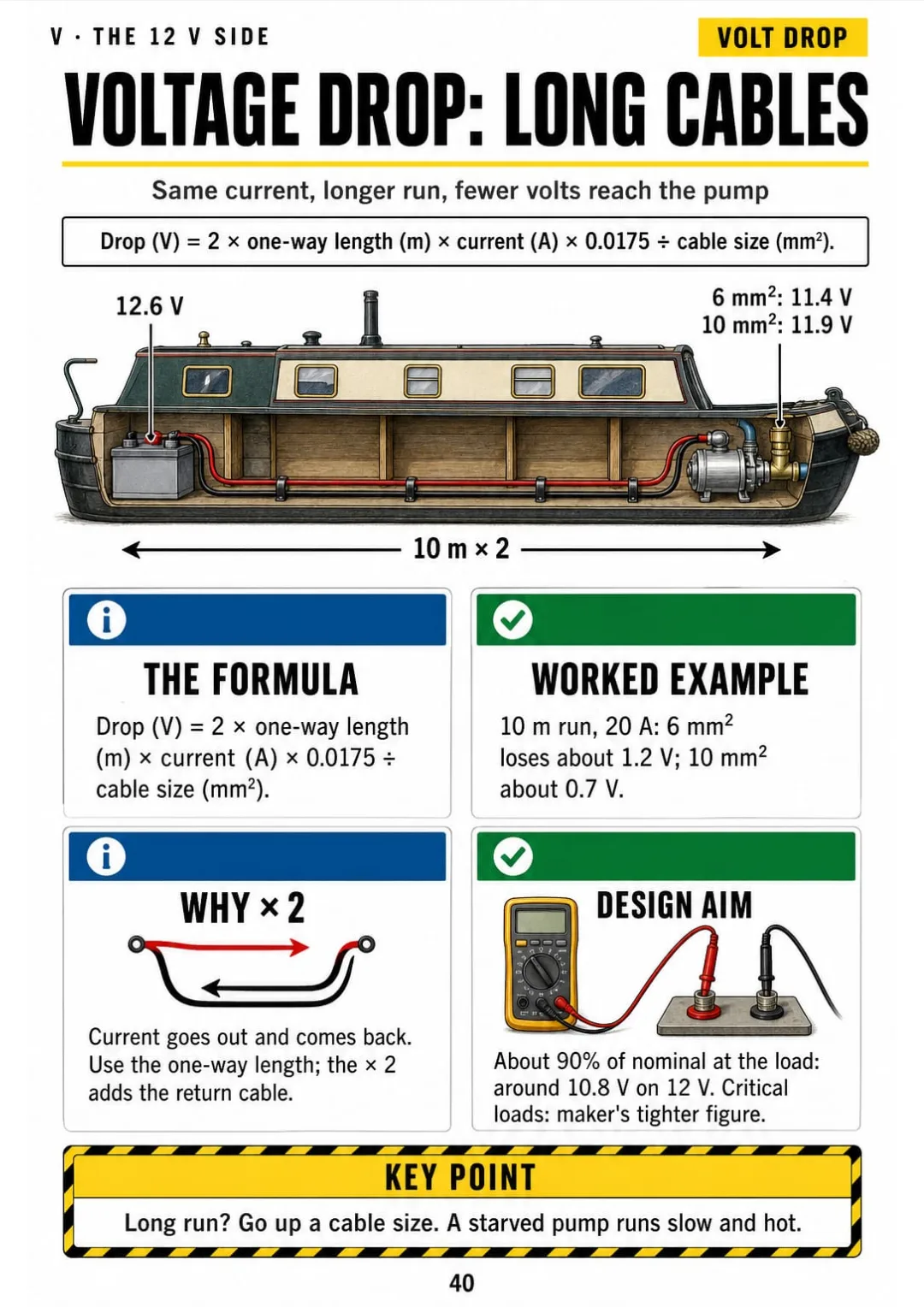
10 m, 20 A: 6 mm² drops about 1.2 V, 10 mm² about 0.7 V
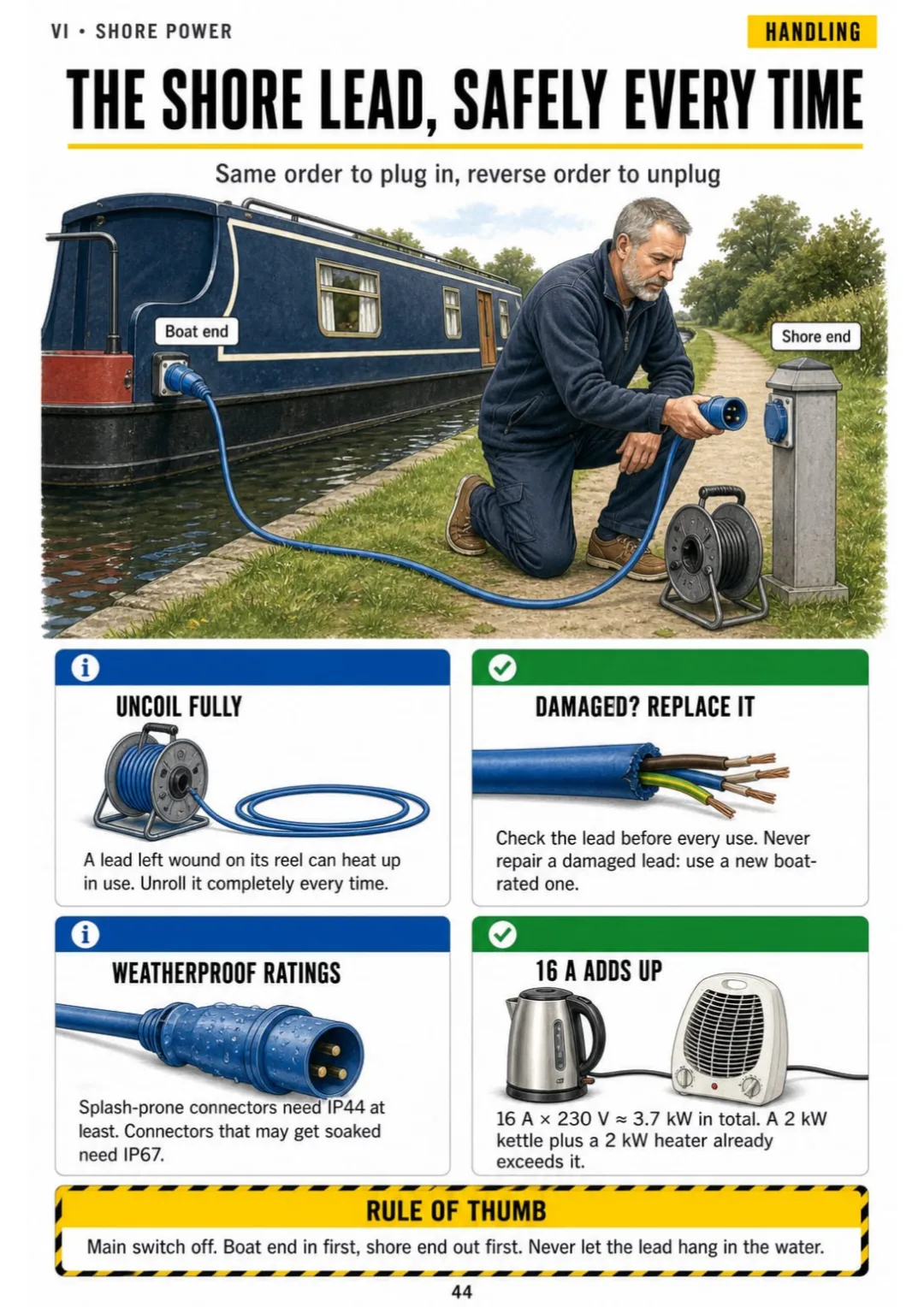
Boat end first, shore end last; unplug the other way round, main switch off
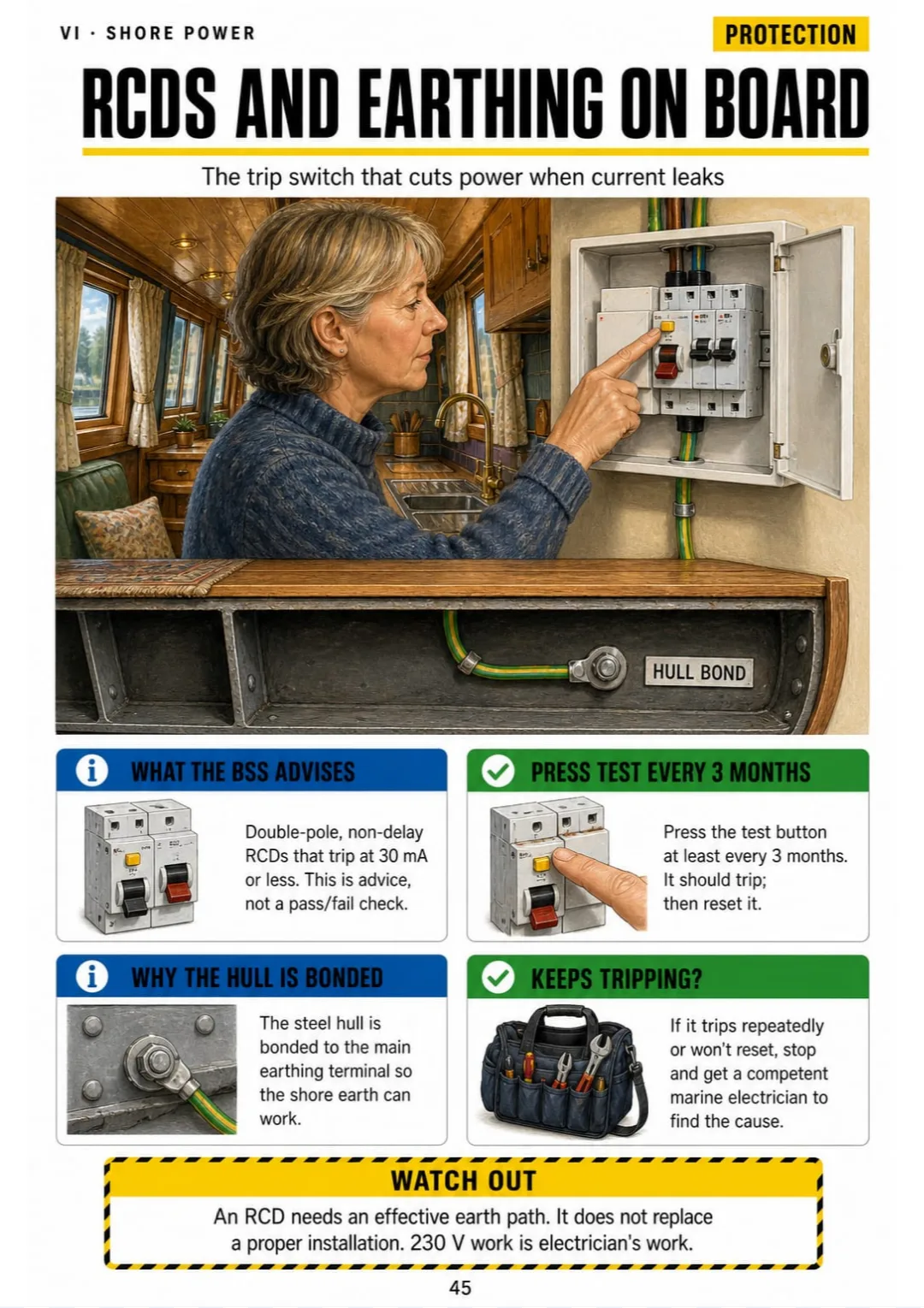
30 mA, double-pole, tested every 3 months: the BSS advice for RCDs on board
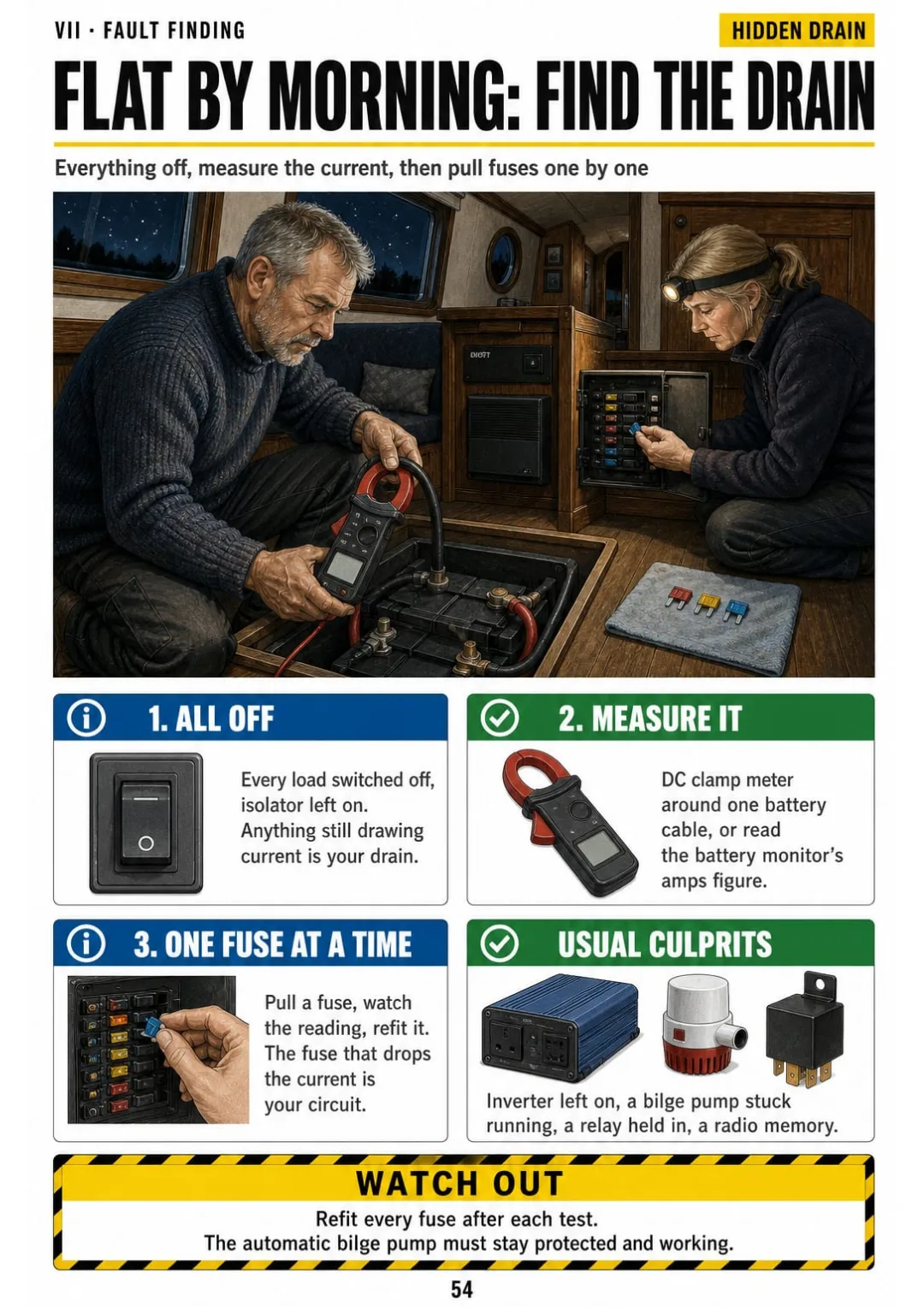
All loads off, clamp meter on the cable, fuses out one by one: the drop shows the culprit.
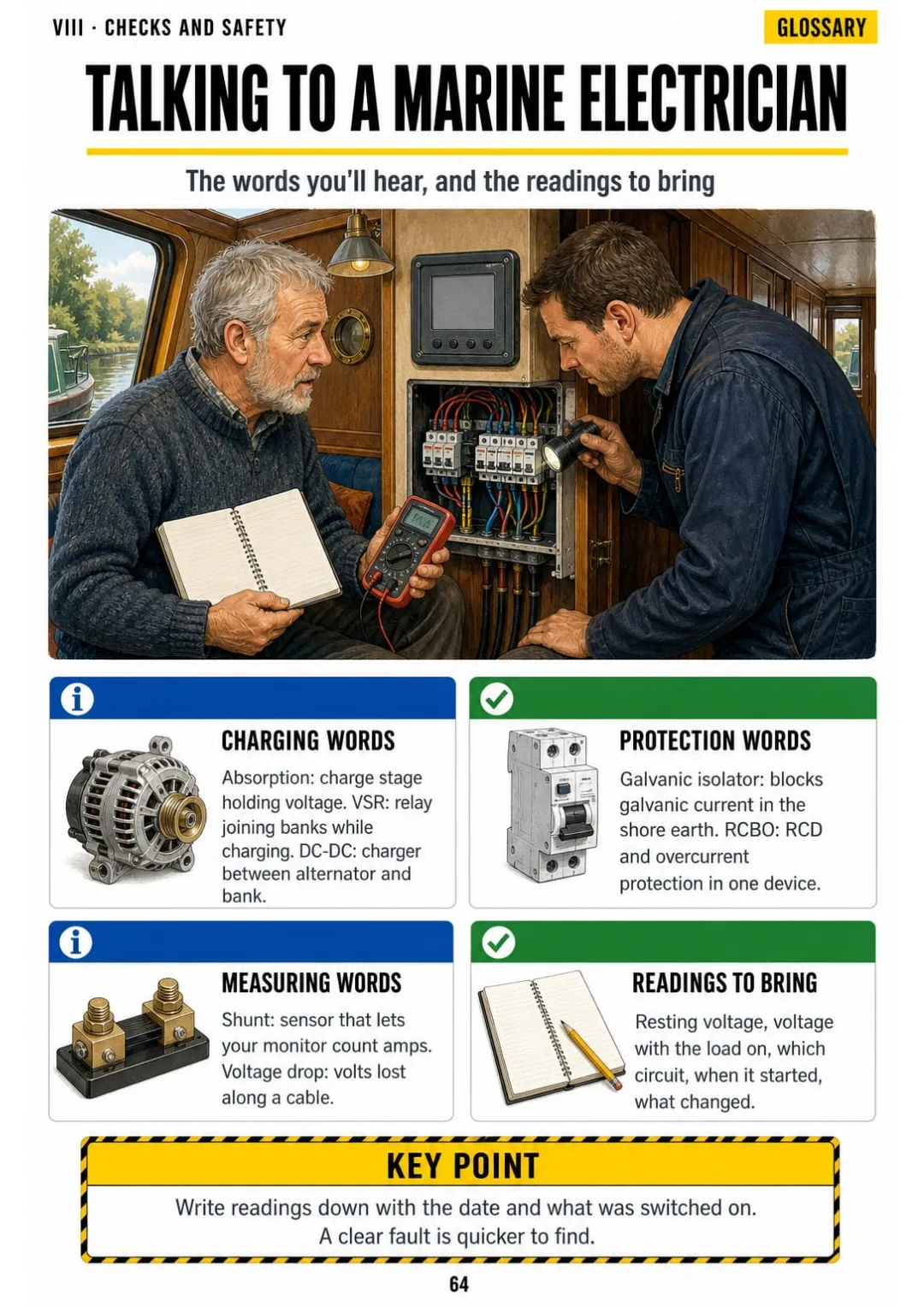
7 words every marine electrician uses, each explained in one line
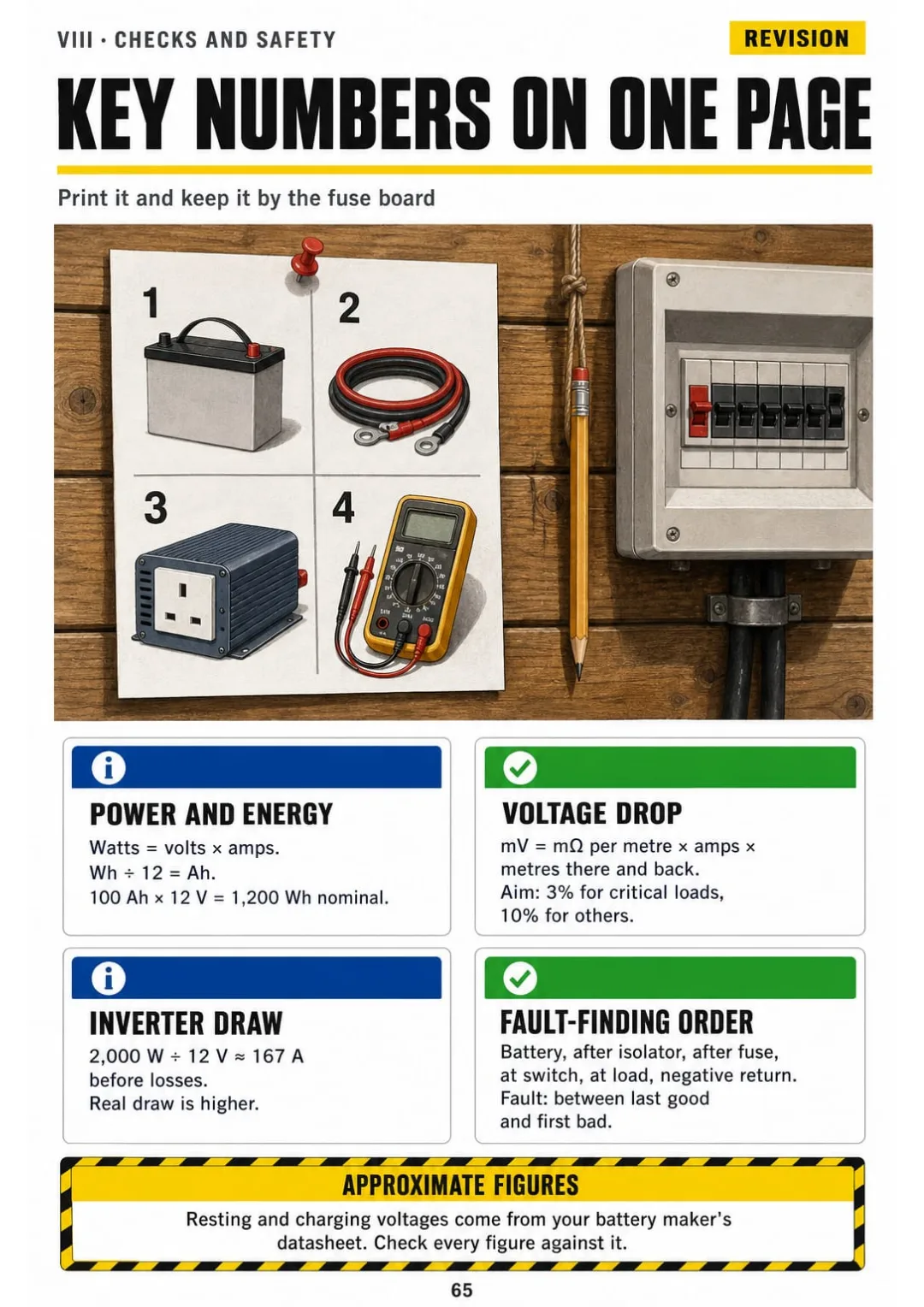
Watts, amp-hours, voltage drop and inverter draw on one printable sheet

Swipe to see more →

These are real pages from the book. The table of contents is the full one: 8 parts and 61 topics.

The Problem Isn't You. It's How It Was Explained.

You're at the bow: the lights are dim and the water pump whines and crawls, yet the voltmeter at the stern says the bank is full. Somewhere along the cable, volts are going missing.

You look it up and get a paragraph on conductor resistance, a formula and a table that doesn't match your boat. Lots of words, and no picture of your own cable run.

10 m, 20 A: 6 mm² drops about 1.2 V, 10 mm² about 0.7 V

Here, voltage drop is one page: a long red cable from the battery to the fuse board up front, ten metres carrying 20 A, and two boxes side by side. 6 mm² loses about 1.2 V. 10 mm² loses about 0.7 V. You can see where the pump's volts go.

Split charging, state of charge, the shore lead from the bollard, what the inverter pulls and fault finding with a multimeter work the same way: each one has its own page.

So you know why the pump is slow, you pick the right cable and you sort it out without going back to the manual.

COMPARE FOR YOURSELF

The Same Topic, Two Ways to Learn It

THIS
  • Forums and videos: ten answers, none for your boat
  • Split charging explained only in words
  • You talk to the electrician still unsure
Where a single alternator supplies both the engine starting battery and the domestic battery bank, a means of split charging is required to permit simultaneous charging while preventing the discharge of one battery into the other. Blocking diodes achieve isolation but introduce a forward voltage drop of approximately 0.6 to 0.7 V, which may result in chronic undercharging unless compensated. Voltage-sensitive relays connect the batteries once a threshold voltage, typically in the region of 13.3 V, is sensed, whereas DC-DC chargers regulate output and are generally preferred for lithium installations.
FOR THIS
  • Diode, VSR and DC-DC in one drawing
  • The voltages in a box
  • You see it and it makes sense
Diode loses about 0.6–0.7 V; a VSR joins at about 13.3 V; DC-DC suits lithium.
CONTENTS

Take a Look at the 8 Parts and 61 Topics

Your boat at a glance, the battery bank, charging, solar, the 12 V side, shore power and the inverter, fault finding, and checks and safety: 65 pages, all illustrated.

IYour Boat's Electrics at a Glance · pp. 5-11
  1. The Whole System in One Drawing
  2. Volts, Amps and Watts Without the Maths Fog
  3. Amp-hours and Watt-hours: How Energy Is Counted
  4. Two Worlds on Board: 12 V DC and 230 V AC
  5. Engine Battery vs Domestic Bank
  6. Positive, Negative and the Hull
  7. Reading Your Boat's Wiring Colours
IIThe Battery Bank · pp. 12-20
  1. Lead-acid, AGM, Gel and Lithium Side by Side
  2. What the Label on Your Battery Means
  3. State of Charge from the Resting Voltage
  4. Why Lithium Voltage Tells You Almost Nothing
  5. The 50% Rule for Lead-acid Banks
  6. Wiring a Bank: Parallel and Series
  7. Sulphation: How Lead-acid Banks Die
  8. Battery Boxes, Venting and Securing
  9. The Battery Isolator Switch
IIICharging on the Move and at the Mooring · pp. 21-28
  1. The Three Charging Stages: Bulk, Absorption, Float
  2. How the Alternator Charges Your Batteries
  3. Two Alternators: Starter and Domestic
  4. Split Charging: Diode, Relay (VSR) and DC-DC
  5. Protecting the Alternator When You Go Lithium
  6. The Mains Battery Charger
  7. Charging with a Generator
  8. How Long Do I Need to Run the Engine?
IVSolar Power on the Roof · pp. 29-34
  1. How a Solar Panel Feeds the Bank
  2. PWM vs MPPT Controllers
  3. UK Solar Yield: Summer vs Winter
  4. Shading, Angles and Mounting on a Narrowboat Roof
  5. Worked Example: Can Solar Run My Fridge?
  6. Reading Your Solar Controller
VThe 12 V Side: Fuses, Cables and the Panel · pp. 35-42
  1. Your Daily Energy Budget
  2. The Hidden Drains: Inverter Idle and Standby
  3. The Fuse Board Explained
  4. Main Fuse Close to the Battery
  5. Fuses Protect the Cable, Not the Appliance
  6. Voltage Drop: Why Long Cables Starve Your Pump
  7. Choosing Cable Size Step by Step
  8. Crimps, Lugs and Connections That Last
VIShore Power, the Inverter and 230 V · pp. 43-50
  1. From the Bollard to Your Sockets
  2. The Shore Lead: Plug, Socket and Handling
  3. RCDs and Earthing on Board
  4. Galvanic Isolator and Isolation Transformer
  5. Reverse Polarity and Odd Marina Supplies
  6. Inverters: Pure Sine vs Modified
  7. What a 2,000 W Inverter Really Takes from the Battery
  8. Inverter Safety: Earth, RCD and the Changeover
VIIFault Finding with a Multimeter · pp. 51-58
  1. Your Multimeter: Four Settings You Need
  2. The Fault-finding Order: Always the Same Steps
  3. The Voltage Drop Test Under Load
  4. Batteries Flat in the Morning: Finding the Drain
  5. Is the Alternator Charging?
  6. Is It the Battery or the Charging?
  7. Solar Not Charging: Panel to Battery Checks
  8. Pump, Lights or Fridge Dead: One Circuit at a Time
VIIIChecks, Safety and Quick Revision · pp. 59-65
  1. What You Can Check and What to Leave to a Professional
  2. Electrics and the Boat Safety Scheme Examination
  3. Monthly Walk-round Checklist
  4. Winter Afloat and Laying Up
  5. The Most Common Wiring Mistakes on Narrowboats
  6. Talking to a Marine Electrician
  7. Key Numbers on One Page

One Page, One Topic, All Clear

Think of it this way:

It's a grey February morning on the towpath. The lights are dim and you want to know whether the alternator actually charged anything yesterday.

You open the alternator page: engine, alternator and bank drawn in a row, with the readings to look for, engine off and engine running, in a box.

30 mA, double-pole, tested every 3 months: the BSS advice for RCDs on board

The 50% rule, winter solar yield, the shore lead, the inverter's draw and the overnight drain work the same way: each one sits on its own page.

Narrowboat Electrics Illustrated is 65 illustrated pages in 8 parts, one topic per page, with every key number on one printable page at the end.

What you see drawn, you don't have to memorize.

What's Inside Narrowboat Electrics Illustrated:

Ipp. 5-11

Your Boat's Electrics at a Glance

See your whole system in one drawing before you touch a wire: volts, amps and watts, amp-hours, 12 V vs 230 V, engine battery vs domestic bank, the hull and wiring colours.

IIpp. 12-20

The Battery Bank

Lead-acid, AGM, gel and lithium, battery labels, state of charge from resting voltage, the 50% rule, parallel and series, sulphation, boxes and the isolator.

IIIpp. 21-28

Charging on the Move and at the Mooring

Bulk, absorption and float, the alternator, two alternators, diode, VSR and DC-DC, going lithium, the mains charger, generators and engine running time.

IVpp. 29-34

Solar Power on the Roof

How a panel feeds the bank, PWM vs MPPT, UK summer and winter yield, shading and mounting, a fridge worked example and reading your controller.

Vpp. 35-42

The 12 V Side: Fuses, Cables and the Panel

Your daily energy budget, hidden drains, the fuse board, the main fuse, what fuses protect, voltage drop, cable sizing step by step and crimps that last.

VIpp. 43-50

Shore Power, the Inverter and 230 V

Bollard to sockets, the shore lead, RCDs and earthing, galvanic isolator and transformer, reverse polarity, pure vs modified sine, inverter draw and inverter safety.

VIIpp. 51-58

Fault Finding with a Multimeter

Four multimeter settings, the six-step fault-finding order, the voltage drop test, the overnight drain, alternator, battery, solar and single-circuit checks.

VIIIpp. 59-65

Checks, Safety and Quick Revision

What you can check yourself, electrics at the boat safety inspection, a monthly walk-round, winter afloat, the most common wiring mistakes, talking to an electrician and key numbers.

At the end of the book: Worked examples, a guide to what you can check yourself, and every key number on one printable page.
Plus: 2 Free Books

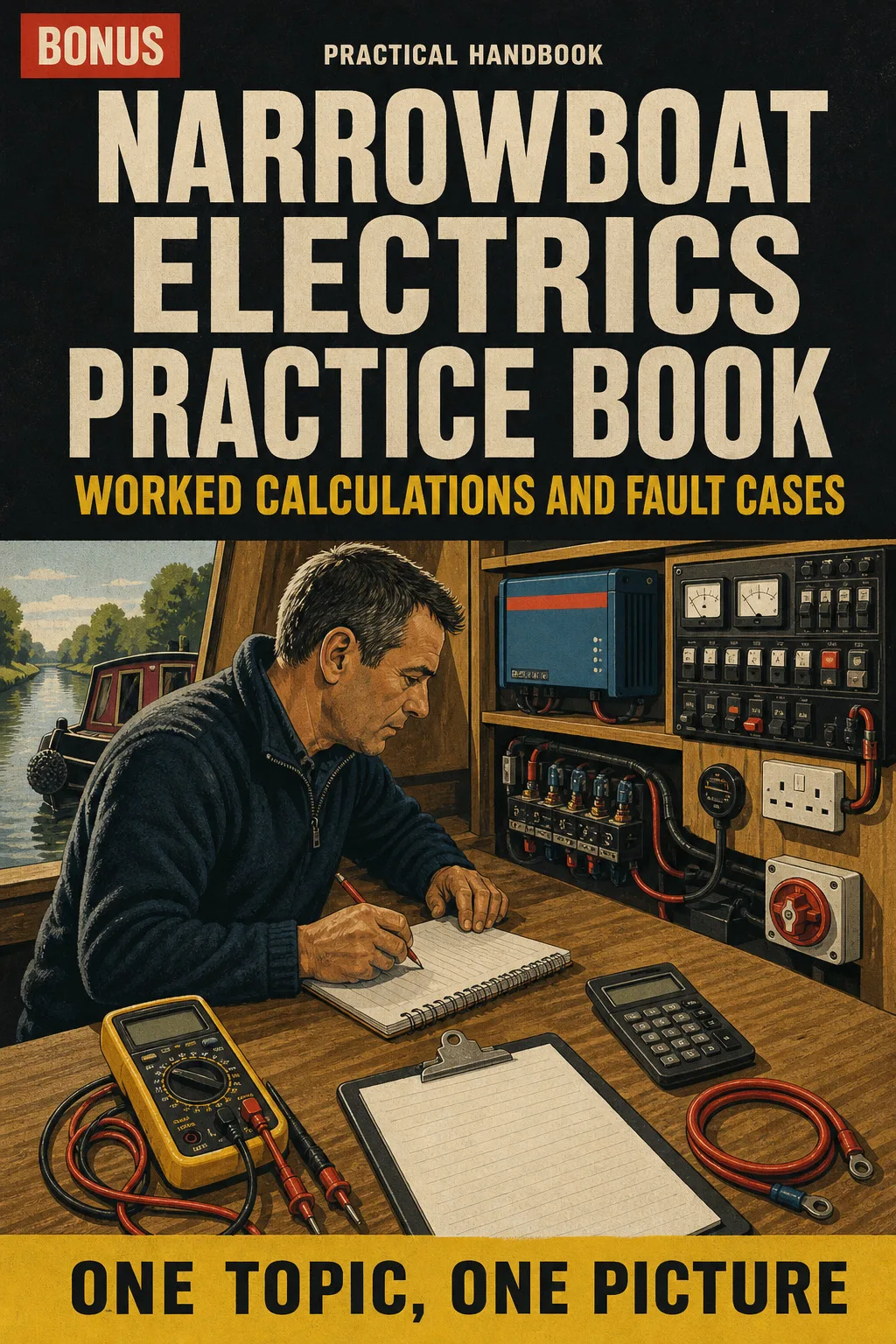
Narrowboat Electrics Practice Book: Worked Calculations and Fault Cases

BONUS 1: «Narrowboat Electrics Practice Book: Worked Calculations and Fault Cases»

Value on its own: US$ 17.90

Practise the sums that matter on board (daily use, bank size, solar yield, voltage drop) and work through real-life faults step by step, with the answers drawn out.

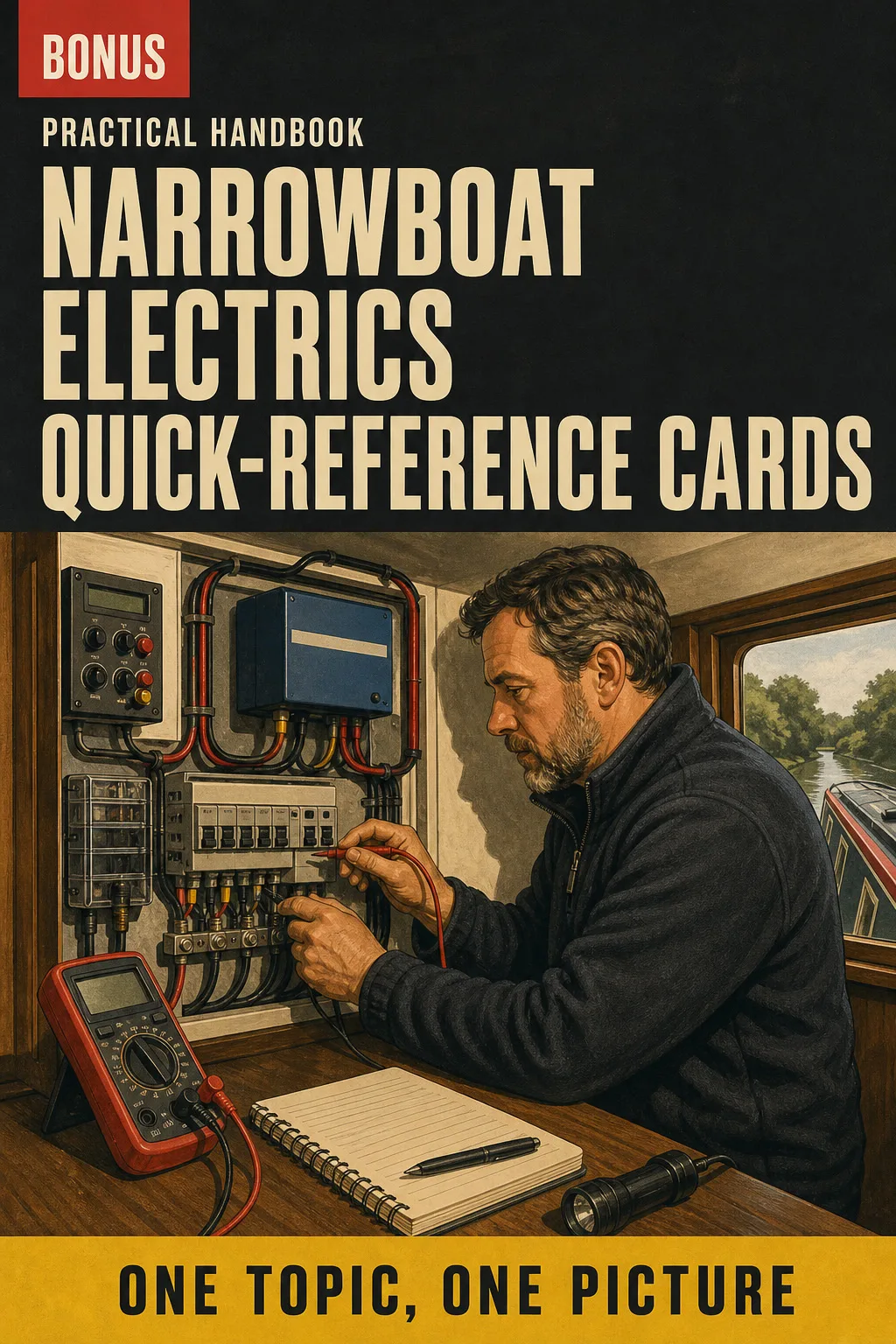
Narrowboat Electrics Quick-Reference Cards

BONUS 2: «Narrowboat Electrics Quick-Reference Cards»

Value on its own: US$ 14.90

The key voltages, state-of-charge readings, multimeter steps and the most common wiring mistakes on printable cards to keep by the switch panel.

Narrowboat Electrics Illustrated with 2 Free Books

  • Narrowboat Electrics Illustrated: 65 illustrated pagesUS$ 63
  • BONUS 1: Narrowboat Electrics Practice Book: Worked Calculations and Fault CasesUS$ 17.90
  • BONUS 2: Narrowboat Electrics Quick-Reference CardsUS$ 14.90
  • High-resolution PDF to printIncluded
Total value US$ 95.80
YOUR PRICE:
US$ 27
You save US$ 68.80
YES, I WANT NARROWBOAT ELECTRICS ILLUSTRATED FOR US$ 27

📄 This is a digital PDF book sent to your email: nothing is printed or shipped.

Secure purchaseEncrypted payment30-day guarantee

PDF by email: We email you Narrowboat Electrics Illustrated as a PDF, together with the two free books. It's a single payment: no installments, no extra charges.

Who This Book Is For

You've just bought your boat

You've just bought your boat

The wiring came from the last owner, unlabelled. You see the whole system in one drawing first, then each part on its own page.

Your boat safety inspection is coming up

Your boat safety inspection is coming up

Battery securing, the isolator, cable support: you see what gets checked and can walk round your boat before the examiner does.

You live aboard all year

You live aboard all year

Your lights, pump and fridge all run off one bank. You work out your daily use, charge properly through the winter and find faults in the same order every time.

Everything You Get Today

US$ 95.80US$ 27
YES, I WANT NARROWBOAT ELECTRICS ILLUSTRATED FOR US$ 27

📄 This is a digital PDF book sent to your email: nothing is printed or shipped.

30DAYS
GUARANTEE

30-Day Guarantee

Try Narrowboat Electrics Illustrated for 30 days, bonus books included.

We refund everything if the file won't open, if the book isn't what you see here, if you were charged twice or if the email doesn't arrive. Just email us.

You pay once. No subscriptions.

Frequently Asked Questions

Is it for me if I've just bought a narrowboat and the wiring came with it?

Yes. It starts with volts, amps and the whole boat in one drawing, then goes one part at a time. It doesn't assume you're an electrician.

Is it for UK boats, and where does the content come from?

It's written for UK narrowboats: a 12 V domestic bank, 230 V shore power from UK bollards and cable sizes in mm². The checks follow the Boat Safety Scheme's guide to its examination checks, BS EN ISO 13297 (small craft electrics) and BS 7671 Section 709 (marinas). Every voltage, interval and rule is marked so you can check it against the current version. The drawings and tables are our own.

Is it official material?

No. It's an independent illustrated book. It isn't affiliated with or endorsed by the Boat Safety Scheme, the Canal & River Trust or BSI.

Does it replace a marine electrician or a course?

No. It helps you understand your system and check what you safely can. Any work on 230 V belongs to a qualified marine electrician, and the book shows you where that line is.

Are the practice cases the ones from the boat safety inspection?

No. The calculations and fault cases were written for this book. They aren't official questions or checks.

When and how do I get it?

As a PDF by email, sent to the address you enter when you pay.

Do I have to pay every month?

No. You pay once, and the book and both free books are yours to keep.

Can I have it on paper?

Yes. Print the PDF at home or at a print shop and keep it on board by the switch panel.

How does the refund work?

You have 30 days. We refund everything if the file won't open, if the book isn't what you see on this page, if you were charged twice or if the email doesn't arrive: just email us.

Before You Close This Page

No more forum threads that contradict each other.

Split charging, voltage drop, the shore lead: you see it drawn, and that's it.

You step aboard knowing where everything is.

Drawings make studying faster.

The book is right below.

One-time payment: US$ 27 · Guarantee: 30 days · PDF by email

YES, I WANT NARROWBOAT ELECTRICS ILLUSTRATED FOR US$ 27

📄 This is a digital PDF book sent to your email: nothing is printed or shipped.